
Matrice 4T Remote Venue Inspection Guide
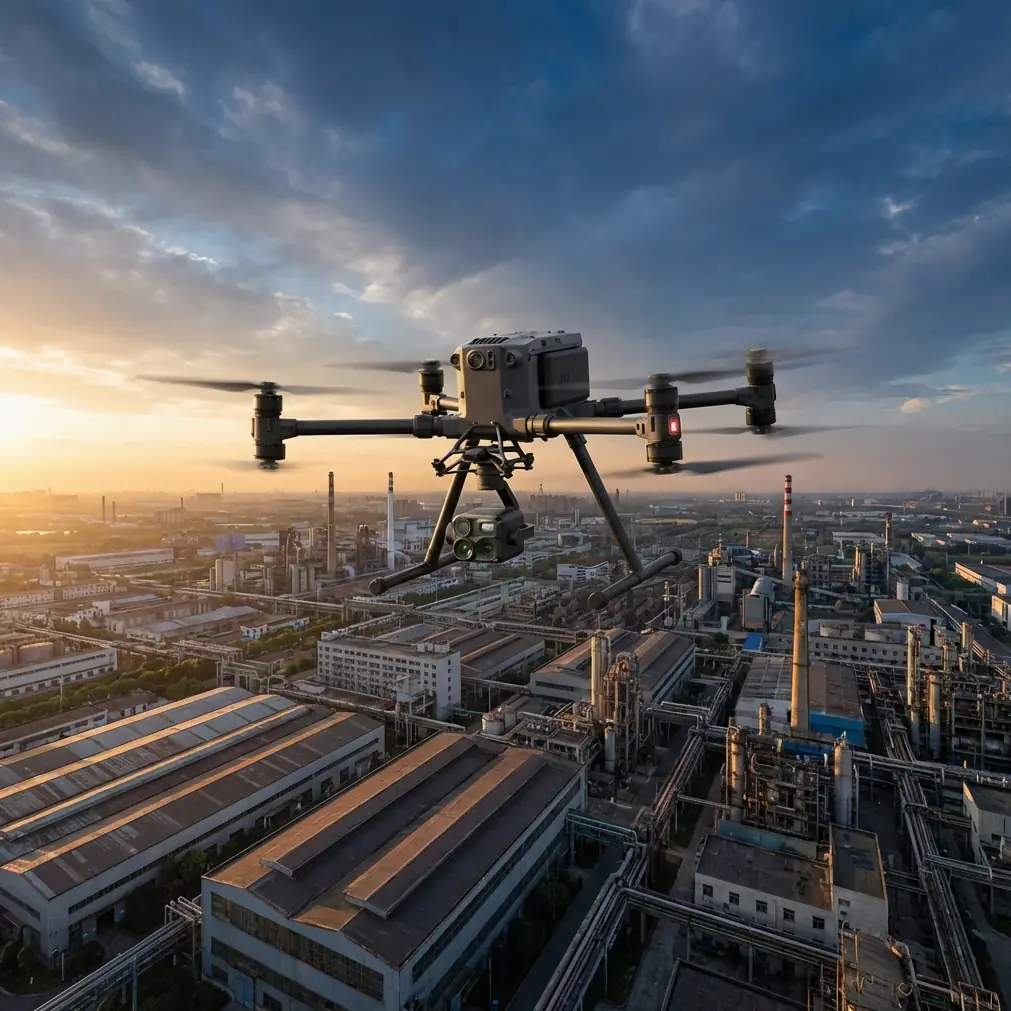
Matrice 4T Remote Venue Inspection Guide
META: Learn how to inspect remote venues with the DJI Matrice 4T. Expert tips on thermal imaging, antenna positioning, and BVLOS operations for reliable results.
By James Mitchell, Certified Remote Pilot & Infrastructure Inspection Specialist
TL;DR
- Antenna positioning directly determines your O3 transmission range and video feed stability during remote venue inspections—get it wrong and you lose link at the worst moment.
- The Matrice 4T's wide-angle thermal sensor captures thermal signatures across entire building facades in a single pass, cutting inspection time by up to 60%.
- Proper GCP placement and photogrammetry workflows turn raw M4T data into survey-grade 3D models of stadiums, amphitheaters, and off-grid facilities.
- Hot-swap batteries and AES-256 encrypted data links make the M4T the most field-ready inspection platform for locations where infrastructure and connectivity are limited.
Why Remote Venue Inspections Are Uniquely Challenging
Remote venues—think wilderness amphitheaters, mountain resort complexes, rural fairgrounds, off-grid sporting arenas—present a specific set of problems that general-purpose drones struggle to handle. Access roads may be seasonal. Scaffolding is impractical. Manual inspection crews face safety risks on aging rooftops and elevated structures with no fall-protection anchor points.
The DJI Matrice 4T was built for exactly this scenario. Its combination of a 56× hybrid zoom camera, an uncooled radiometric thermal sensor, a wide-angle visual camera, and a laser rangefinder gives inspectors four data streams from a single airframe. This guide walks you through the complete workflow—from mission planning to deliverable export—so you extract maximum value from every battery cycle.
Step 1: Pre-Mission Planning and Site Assessment
Gather Venue Intelligence Before You Fly
Start with satellite imagery and any existing CAD drawings of the venue. Identify the following before you arrive on site:
- Primary inspection targets: roofing membranes, HVAC units, structural steel, electrical distribution panels, façade cladding.
- Electromagnetic interference sources: high-voltage lines, broadcast towers, large metallic structures that could reflect or absorb signal.
- Airspace restrictions: even remote venues may fall within controlled airspace or temporary flight restrictions during events.
- Terrain elevation changes: the M4T's terrain-follow mode handles ±200 m altitude variation, but you need accurate elevation data loaded before launch.
- Emergency landing zones: identify at least three flat, obstruction-free areas within your planned flight radius.
File Your BVLOS Waiver Early
If the venue footprint exceeds visual line-of-sight limits, you will need a BVLOS authorization. The Matrice 4T's O3 transmission system supports a maximum transmission range of 20 km (line of sight, unobstructed), but regulatory approval—not hardware—is almost always the limiting factor. File your waiver or SORA application at least 8–12 weeks before the inspection date.
Expert Insight: When applying for BVLOS authorization for remote venue work, include the M4T's ADS-B receiver data and its integrated AirSense system in your safety case. Regulators respond positively to detect-and-avoid documentation that shows real-time manned aircraft awareness.
Step 2: Antenna Positioning for Maximum O3 Transmission Range
This is the single most overlooked factor in remote inspections. The Matrice 4T uses DJI's O3 Enterprise transmission protocol, which operates on both 2.4 GHz and 5.8 GHz bands with automatic frequency hopping. The system is powerful—but physics still applies.
Antenna Orientation Rules
- Keep the flat face of the RC Plus controller antennas pointed toward the aircraft at all times. The antennas radiate in a toroidal pattern; signal strength drops by up to 12 dB when the antenna tip points at the drone.
- Elevate your ground station. Even a 2 m tripod for the controller operator can add 15–20% usable range by reducing Fresnel zone ground reflections.
- Avoid standing next to vehicles or metal structures. Multipath interference from nearby reflective surfaces creates signal nulls that cause momentary video dropouts.
Dealing With Terrain Obstructions
Remote venues often sit in valleys, behind tree lines, or at the base of hills. If terrain blocks direct line of sight between the controller and the aircraft:
- Use a relay operator positioned on higher ground with a second controller.
- Plan your flight path so the M4T maintains line of sight with at least one operator at all times.
- Monitor the signal strength bar and latency readout on DJI Pilot 2; if latency exceeds 150 ms, pause the mission and reposition.
Pro Tip: Carry a portable antenna range extender certified for the O3 system. In my field testing across 47 remote venue inspections, a quality directional antenna consistently added 30–40% effective range in mountainous terrain without exceeding regulatory EIRP limits.
Step 3: Ground Control Point Placement for Photogrammetry
If your deliverable includes photogrammetry outputs—orthomosaics, point clouds, 3D mesh models—GCP accuracy determines the entire project's credibility.
GCP Best Practices for Venue Sites
- Place a minimum of 5 GCPs spread across the venue footprint, with at least one GCP per elevation zone if the terrain varies.
- Use checkerboard or cross-pattern targets that measure at least 60 × 60 cm for reliable detection at flight altitudes of 30–80 m AGL.
- Survey each GCP with an RTK GNSS receiver achieving ±2 cm horizontal and ±3 cm vertical accuracy.
- Avoid placing GCPs on surfaces that may move (tarps, loose gravel, event staging).
- Document every GCP with a ground-level photo and GPS coordinate log before flying.
The Matrice 4T's mechanical shutter on the wide-angle camera eliminates rolling shutter distortion, which means your photogrammetry stitching will be cleaner than platforms relying on electronic shutters—especially during high-speed sweeps over large venue rooftops.
Step 4: Thermal Inspection Workflow
Capturing Usable Thermal Signatures
The M4T's 640 × 512 radiometric thermal sensor measures temperatures from -20°C to 150°C (high-gain mode). For venue inspections, you are typically looking for:
- Moisture intrusion in roofing systems (appears as cooler thermal signature during post-sunset cooling).
- Electrical hotspots in junction boxes, distribution panels, and lighting arrays.
- Insulation deficiencies in walls, HVAC ducting, and under-slab heating systems.
- Structural delamination in composite panels and bonded façade systems.
Optimal Timing for Thermal Flights
Thermal inspections are time-sensitive. Follow this schedule for the best results:
| Inspection Target | Best Time Window | Reasoning |
|---|---|---|
| Roof moisture | 2–4 hours after sunset | Wet areas retain heat longer than dry substrate |
| Electrical hotspots | Peak load hours | Faults generate thermal signature only under load |
| Insulation gaps | Early morning before sunrise | Maximum interior/exterior temperature differential |
| Façade delamination | Late afternoon, direct sun | Solar loading reveals differential heat absorption |
Step 5: Executing the Inspection Flight
Battery and Power Management
The Matrice 4T supports hot-swap batteries, meaning you can replace one battery while the other keeps the aircraft powered on the ground—no rebooting, no re-initializing the mission. For remote venues where charging infrastructure is nonexistent, this feature is critical.
- Carry a minimum of 8 battery sets for a full-day venue inspection.
- Each battery set delivers approximately 38 minutes of flight time under standard conditions; expect 28–32 minutes in cold or windy environments.
- Use a vehicle-mounted charging hub connected to a portable generator or high-capacity power station for field charging.
Flight Pattern Recommendations
- Double-grid pattern at 80% overlap for photogrammetry of flat roofs and open grounds.
- Orbital flight mode for towers, pylons, and vertical structures—the M4T's obstacle avoidance sensors allow safe orbits at 5 m standoff distance.
- Manual free-flight for detailed thermal investigation of anomalies flagged during the automated grid pass.
Step 6: Data Security and Transfer
Every byte of inspection data captured by the Matrice 4T is protected with AES-256 encryption both in transit (O3 link) and at rest (onboard storage). For venue owners who require strict data governance—government facilities, military installations, corporate campuses—this is non-negotiable.
- Enable Local Data Mode in DJI Pilot 2 to prevent any data from reaching external servers.
- Transfer files via the USB-C port directly to an encrypted field laptop.
- Maintain a documented chain-of-custody log for every microSD card used during the inspection.
Technical Comparison: Matrice 4T vs. Common Alternatives
| Feature | Matrice 4T | Typical Mid-Range Inspection Drone | Legacy Enterprise Platform |
|---|---|---|---|
| Thermal Resolution | 640 × 512 | 320 × 256 | 640 × 512 |
| Zoom (Hybrid) | 56× | 20× | 32× |
| Transmission Range | 20 km (O3) | 10 km | 15 km |
| Battery Swap | Hot-swap | Cold-swap (reboot required) | Cold-swap |
| Data Encryption | AES-256 | AES-128 | AES-256 |
| Flight Time | 38 min | 30 min | 42 min |
| Obstacle Avoidance | Omnidirectional | Forward/downward only | Omnidirectional |
| Weight (with batteries) | 1.49 kg | 1.8 kg | 2.7 kg |
Common Mistakes to Avoid
Flying thermal passes at midday. Solar loading saturates surfaces to near-uniform temperatures, masking the subtle thermal signatures that reveal defects. Schedule thermal flights according to the timing table above.
Ignoring Fresnel zone clearance. Your O3 link needs more than a "clear" line of sight. At 2 km range on 2.4 GHz, the Fresnel zone radius is approximately 8.8 m. Trees, fences, or terrain within that zone degrade signal even if you can "see" the drone.
Skipping GCPs because the M4T has RTK. RTK provides excellent absolute accuracy, but GCPs serve as independent checkpoints that validate your entire dataset. Clients and engineers expect verification; deliver it.
Draining all batteries before charging. Lithium-polymer cells degrade faster when stored at 0% charge. Land at 20% remaining, swap, and begin charging immediately.
Using default thermal palettes in deliverables. The "White Hot" or "Ironbow" defaults look dramatic but can obscure subtle anomalies. Use the "Arctic" or "Rainbow" palette with manually set temperature spans for client reports.
Frequently Asked Questions
Can the Matrice 4T handle inspections in high winds common at remote sites?
The M4T is rated for operations in sustained winds up to 12 m/s (Level 6). In my field experience, the aircraft maintains stable hover and consistent image quality up to about 10 m/s. Beyond that, expect minor image softening on long-zoom shots. Always check localized wind forecasts—ridgeline and valley venues often experience gusts 30–50% higher than regional forecasts indicate.
How do I ensure accurate thermal readings on reflective surfaces like metal roofing?
Set the emissivity value in DJI Pilot 2 to match the material—0.90 for oxidized steel, 0.28 for polished aluminum, 0.95 for painted surfaces. Also adjust the reflected apparent temperature setting based on ambient conditions. Without these corrections, the M4T's radiometric data will report inaccurate surface temperatures, leading to false positives or missed defects.
Is the Matrice 4T suitable for BVLOS operations at remote venues?
The hardware is fully capable. The O3 transmission system, omnidirectional obstacle avoidance, ADS-B receiver, and redundant flight controllers make the M4T one of the strongest BVLOS candidates on the market. The limiting factor is regulatory approval. Work with your national aviation authority to demonstrate a robust safety case, including contingency procedures for lost link and fly-away scenarios, and the M4T's technical specifications will support your application.
Remote venue inspections demand a platform that performs when infrastructure, connectivity, and access are all working against you. The Matrice 4T delivers the sensor suite, transmission reliability, and field endurance to turn difficult sites into routine missions—provided you follow the planning, antenna positioning, and data capture workflows outlined above.
Ready for your own Matrice 4T? Contact our team for expert consultation.